best wine ever tasted
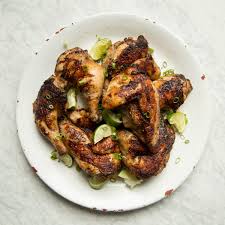
How to make this recipe In a food processor, combine the onion, scallions, chiles, garlic, five-spice powder, allspice, pepper, thyme, nutmeg and salt; process to a coarse paste. With the machine on, add the the soy sauce and oil in a steady stream. Pour the marinade into a large, shallow dish, add the chicken and turn to coat. Cover and refrigerate overnight. Bring the chicken to room temperature before proceeding.Grill the chicken over a medium-hot fire, turning occasionally, until well browned and cooked through, 35 to 40 minutes. (Cover the grill for a smokier flavor.) Transfer the chicken to a platter and serve. Aggregate Rating value: 5 Author Name: Terry L. Brown Review Body: I am trying this to night. Where to Find our Wine Visit Us At The Windmill Reserve A Room Online Fish & Brew Fridays Simply Steak & Potato Trestle Creek Hard Cider Gifts and Gift Cards Earn Rewards at Glenora Ship and Sip Wine Club Meet our Wedding Team

Sunday 29 March 2015 00:00 GMT I was tasting at least 10,000 wines a year until recently – which makes around 350,000 altogether. That's a bare minimum. I'm still standing and my liver function is still OK. I take milk thistle for my liver and try to drink three times as much water to wine.
buy wine journalIf I've been tasting, I don't usually drink wine in the evening.
top 10 wine brand in australiaI have a good memory of all the great meals and great wines I have tasted I can remember what a pristine bottle of 1947 Cheval Blanc tastes like.
wine for cats priceI've been quoted as saying I can remember every wine I've tasted.
best wine programs nycI never said that. I've forgotten all the mediocre ones.

You risk losing readers if you make things complicated In The Wine Advocate, which I founded in the late 1970s, we describe wine in ways that people understand, avoiding esoteric terms. You might describe someone you meet as "portly" or "bald" and wine should be no different, so we use terms such as "red fruits", "flowery" and so on. I once had a taster use the phrase "smells like the sex glands of a lemming". Who in the world can relate to that?We keep our distance from the wine trade and refuse their advertising. One of my key influences is Ralph Nader [the American consumer champion]. When I began The Wine Advocate as a newsletter, I wanted to be strict about our independence. There is more flexibility about accepting hospitality – such as lunch at a Bordeaux château – as it's also a learning opportunity. But I wouldn't want to make a habit of it. Most expensive bottles of wine in the world It has been suggested that some makers have modified their wines to my taste to get a high rating It really is selling your soul.

I've no evidence of it, but I have seen photocopies of contracts promising bonuses to wine consultants if they get a 90 or a 95 point rating [out of 100]. That's such a short-sighted objective. There isn't really a formula for it. My taste [Parker has been criticised for seeming to prefer fruit-driven, big-flavour wines] is not nearly as black-and-white as my critics believe.Wines drunk young, such as Beaujolais or Muscadet, cannot be seen in the same way as a Bordeaux or a Burgundy That doesn't mean I don't like them. Some are lovely, exuberant wines, but there is no equivalence to wines that become immeasurably more interesting and nuanced with age.New World wines still struggle to match the greats Old World classics are there because they have endured. The rest is still a work in progress. They still judge what they make against the great wines of places such as Bordeaux.Retirement is a formula for early death Although I've recently had back surgery and have been using walking sticks to get around, I've sold the majority share in The Wine Advocate and I have handed over tasting of the Bordeaux en-primeurs [young wine still in the barrel] to a colleague
, I have no plans to retire. I found this little niche and I've never lost the passion. The idea of losing your sense of taste or smell and having some medical condition where you couldn't have alcohol – I can't think of anything worse than that.A former lawyer turned self-taught wine writer, American Robert Parker, 67, is said to be the world's most influential wine critic, his 100-point scale a benchmark of achievement for wine-makers everywhere. He is currently on a global Grand Tour of tastings and dinners; sampling some of the rarest wines in the world in his company starts at around £450 a head. Take it from Andrew Jefford if you want to write great wine tasting notes; as one of the best wine writers in the modern world, Jefford knows what it takes to write gorgeous, pragmatic prose. , “Numbers alone cannot adequately address the mystery of wine’s complexity; words must be involved.” Yet these words are often the most difficult to get right, even for experienced wine collectors and wine writers.

A study in the found that wine notes written by professionals can baffle readers. Researchers offered participants a list of wine tasting notes along with a few glasses of different wines. Participants failed when ask to match the tasting note to the corresponding wine. Some participants even paired red wine tasting notes with some of the white wines offered. However, you don’t have to fall victim to this confusion yourself. Follow these simple tips for writing wine tasting notes that aren’t just beautiful, but useful too. The first step in writing wine tasting notes that are effective is to approach your writing from your own perspective, not worrying about what readers will think. Ultimately, a tasting note is going to be most useful for the person writing it, not the person reading it. Tasting notes should primarily be for your own use, as a way to jog your memory about a wine and decide if it’s a bottle you would be willing to invest in again. Avoid trying too hard to sound clever or elegant, since this can dilute your meaning and over-complicate the note as a whole.
While you can publish these notes to , you should never start writing a tasting note with your potential readers in mind. As the Wine Economics study found, not all of the flavors you’ll discover during your tasting will necessarily be experienced by your readers anyway. If you taste vanilla, there’s no guarantee that your readers will be able to pick out that flavor when they try the wine. Your own sense of taste and smell are strongly dependent on . This means that your experience of any wine can change dramatically within only a few days. It’s no surprise that the descriptors professional wine critics use to describe the same wine vary so dramatically between reviews, and that their readers often have trouble identifying even a few of the flavors wine critics claim to taste. Jefford suggests avoiding a “fruit salad” when you write about wine. He means that writers should include a handful of specific flavor analogies, rather than describing every taste and smell that comes to mind.

Jefford says, “Limit yourself to half a dozen at most, ideally those with some sensual kinship with one another.” According to this Jefford kinship method, you should list out every flavor you can find in a wine, without editing or judgment, then eliminate them until you’re left with the most essential descriptors. Your first draft of your tasting note will look like a long, random list of words, which you can then use as an outline when you write your final tasting note later. When you outline your tasting note, list out the first aromas of the wine first (that is, the scents that hit your nose the instant you pick up the glass). Next, list out the secondary aromas that you find after smelling the wine again, and after you take your first sip. Follow this list up with a list of tasting descriptors, and finally, finish your outline off with a description of the wine’s aftertaste, and how long its finish is. As an example of the kinship method in action, let’s say you try a wine that tastes like strawberries, pencil shavings, tar, cigars, cotton candy, and vanilla.

You probably don’t want to throw all of those descriptors into your note, since the diversity of flavors will make it hard to get a sense of the essence of the wine. Using all these descriptors makes it tough to tell whether this is a fruity or an earthy wine. Instead, pick out the flavors that best describe the overall feeling that the wine conveys. If the wine made you feel like a kid in a candy shop, all sweet and youthful, only list strawberries, cotton candy and vanilla. If the wine is more complex and earthy, list out the pencil shavings, cigars, and tar flavors. If the wine is a combination of both, decide which aspect is most dominant. Include one or two seemingly opposing descriptors to show the other, less dominant side of the wine (for an earthy wine with a hint of sweetness, tag vanilla onto the earthy descriptors, but for a sweet wine with a hint of earthiness, tag pencil shavings onto the sweet descriptors). Now that you’ve gotten rid of the fruit salad, consider the overall structure of your tasting note using a .
Number your descriptors from most prominent to least prominent. If you taste a wine that instantly reminds you of cedar, you’ll want to put any wood-like descriptors within the first few sentences of your final note. Ask yourself which flavors you notice first, followed by the next most powerful flavor down the line. Use for tasting wines: first, look at the appearance of the wine (note the color, and whether it is clear or dull); next, test the nose of the wine (what it smells like as well as the smell’s intensity); next, test the palate (the wine’s sweetness, flavors, tannins, and length); finally, make conclusions about the wine overall (whether it is inexpensive or expensive and whether it is drinking well now or it needs a few more years in the cellar). Ask yourself, “If I read this note again in a year, will I understand what I wrote?” What differentiates this tasting note from all of the other notes you’ve written before? Repetition is the enemy of any tasting note, whether it is written by an amateur or a professional.
If one of your comments could apply to many other wines you’ve tried, then you’re not being specific enough. However, some wines will have natural overlap in their flavors. For example, Rhone Valley wines all tend to have a gamey taste, so it’s perfectly fine to use smoked meat to describe two different wines from the region. However, you should dig in deeper than this when possible. Do both wines have the exact same smoked meat flavor? Does one remind you more of venison, while the other reminds you of smoky bacon? Listing out their specific differences will help you remember what the wines tasted like, and which you ultimately preferred to drink. Before you go into your tasting, research your notes on wines from the same region, the same producer, or the same vintage to see if you can find connections, and pinpoint where the wines differ from one another. After you’ve written up your tasting note outline, you need to decide whether you enjoyed the wine. This might seem obvious, but it’s an aspect that is actually overlooked by many wine writers.
It’s easy to get absorbed in describing a wine in picturesque terms and forget to mention whether this was a wine you would drink again. Jefford and Robert Parker are successful in this industry in part because they will praise the wines they love and hate in simple terms, telling the reader straight out whether they think a wine is worthwhile. For example, “the greatest vintage I have ever tasted in Bordeaux.” As Jefford explains, Parker’s comments are supposed to galvanize readers, which is why he places such a firm stake in the ground when he writes a review. Even if his readers disagree with his points, his writing is compelling. You don’t have to say that every wine is either the greatest or the worst you’ve ever tasted, but it’s a good idea to note your opinion on a wine even before you’ve written a single word of your final tasting note. Before you write out your tasting note, give the wine a definitive rating on the 100-point scale. Vinfolio makes this easy to do via the on your phone.
Once you’ve scanned the barcode on your bottle, the app prompts you to add a simple point rating on the wine to start. Rate your bottle before you’ve polished off your glass, while it’s fresh in your mind, then go back later to write out your actual tasting note. Be sure to give more detail about your enjoyment than just a rating on the scale, though. When you say a wine is 92 points, you’re not saying all that much, but when you say that wine is well-worth drinking and that you look forward to trying it again in five years, you say far more. After you’ve given the wine a score, ask whether the wine was missing anything. Did it feel like a complete wine, or is something not quite right? If something seems to be missing, can you identify it? Once you’ve determined whether the wine was well-structured, ask yourself these questions, in the following order: Did I enjoy this wine? Why or why not? Would I drink this wine again? Would I drink it one year from now? Would I drink it five years from now?