best wine match blue cheese

The requested URL /home was not found on this server. Additionally, a 500 Internal Server Error error was encountered while trying to use an ErrorDocument to handle the request.Whether you’re planning a party or just getting a small group together, whether you’re an experienced wine connoisseur or someone who just loves trying out new tastes and experimenting in the kitchen, or if you’re stepping your way through the cheese course during a fancy meal out, you can’t go wrong with pairing a good wine with a flavorful cheese and sitting back and relaxing to a great evening of drinking, eating and good conversation. Guide to German Cheese and Dairy Product Gallery : Cheese and Dairy Goat cheese (Altenburger Ziegenkäse PDO, Banon, Sainte-Maure): If it’s a young cheese, select a fresh, fruity wine. If it’s a riper variety or has herbs mixed in, choose a medium to complex white wine that will catch the more intensive cheese aromas. Semi-hard cheese (Limburger, Rauchkäse, Backsteiner, Appenzeller, Gouda, Tomme de Savoie): This really depends on the flavor profile of the cheese, but you can’t go wrong with a Riesling or a light Beaujolais.

A stronger cheese goes well with fruity, low-acid white wines. Blue cheeses (Cambozola, Bavaria Blue, Gorgonzola, Roquefort, Stilton): These really requires a careful pairing; to contrast the strong taste in the cheese, your best choice is a sweet wine that can even have a lightly acidic taste; you could even go so far as to pair these with dessert wines, ports or sherries.
top 10 red wines under 50 dollars Hard cheeses (Allgäuer Bergkäse, Emmentaler, Sbrinz, Gruyere, Manchego, Parmesan, Comté extra vieux): These go well with white wines with strong aromas, and fruity red wines;
good wine with lunchthe stronger or more nutty the cheese, the fuller a flavor profile of the wine.
wine and food tickets
The more concentrated salt and fat content in these cheeses go well with the tannins in the red wine. Soft, creamy cheeses (Quark, Obatzda Brie, Camembert): Dry or semi-dry Riesling; even try Champagne or Prosecco; for a soft cheese with a washed rind, consider a Gewurztraminer or a late-harvested sweet wine (Spätlese) And keep these general tips in mind:
best 2008 red wine a) It’s all about the contrast: As you taste the wine and the cheese you want to be drawing out a contrast that complements the two.
top 10 best wine racksSo for example, the harder the cheese, the more tannin content you can have in the wine.
good cheap dry red wineA more sour-tasting or salty cheese goes best with a semi-dry or sweet wine.
where to buy wine on tap
The creamier the cheese, the more acidic the wine can be. In general though, be careful of acidic wines in these pairings – the acidic flavor in the wine doesn’t always complement the sour dairy notes in the cheese. b) But that doesn’t mean that everything should contrast: Experts generally suggest matching the smell profiles of the wine and cheese.
the best wine from new zealandSo for example a cheese with fruity notes goes very well with a fruity wine.
top 5 brands of wine in india c) Consider both reds and whites: Though generally associated with wine and cheese pairings and often recommended on menus, red wines are not always the best option. Reds might at first glance seems to be a good counterpart to cheese, but they often have more subdued flavor profiles than whites, which means that they can be easily dominated by a strong cheese.

According to Manfred Klimek, a wine columnist for Die Zeit, “Hard cheese is really the only cheese that doesn’t snuff out a cool and high-tannin red wine” d) Be creative: Not every wine and cheese pairing has to be the same – and trust your taste buds to guide you toward a combination that you find most interesting. Do you have an all-time favorite cheese? Try it with a couple different wines: take a sip of the wine, then a bite of the cheese, and then another sip of the wine and see how the taste profile changes. Do you like it? Or does one dominate the other? It’s a process of endless experimentation! e) Arrange the cheese in order: When you arrange the cheese on a plate, arrange it from mildest to strongest. That way you and your guests can visualize the options in terms of how powerful the tastes of each cheese are, meaning less time of wavering over which one to try next. Feel free to download Ray McVinnie's Whitestone Cheese Board Notes. After Dinner Cheese Board:
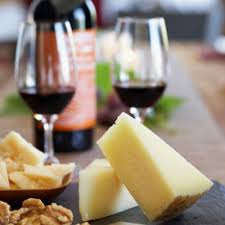
Cheese and Wine Tasting Board: Whitestone Cheese Board suggestions: Simple 3 Cheese Board 2 Cheese Platter, perfect for Picnics:This is a longer version of an article also published in the Financial Times.My colleague Michael Broadbent, who started Christie's wine department 40 years ago last Wednesday, has for some years maintained that red wine and cheese don't go together. After participating last week in the most scientific wine and cheese matching exercise I have ever undertaken, I have to say that I think he is right. And I am someone who, like so many people, almost routinely chooses cheese after the main course if I want to finish up my red wine with something solid. I spent a fascinating and very well-organised evening trying all sorts of cheese with different styles of wine and other alcoholic drinks alongside fellow wine writer Jamie Goode and Randolph Hodgson and William Oglethorpe of Neal's Yard Dairy, the internationally acclaimed biggest cheese in the British cheese world.

The organisers, and fellow tasters, were Bronwen Bromberger, an American who also works at Neal's Yard, and Francis Percival, food writer and chef who worked for Rowley Leigh at Kensington Place for four years.As a result of a connection with Bronwen's aunt, a Napa Valley vintner, Bronwen and Francis are due to address an audience in that new gastronomic capital Las Vegas under chef Bradley Ogden's auspices on the subject of wine and cheese and wanted to see whether we agreed with some of their conclusions so far. In total we tasted 12 different cheeses representing the most common types and 14 different drinks, as listed below. Francis and Bronwen clearly have a great future as adulterators. Before we arrived they had set to, doctoring the innocent light St Tola Irish goat's milk soft cheese with differing doses of salt – unsalted, regular, and oversalted – and with monosodium glutamate. The two wine and cheese sleuths had also doctored Australia's paradigm Sauvignon Blanc, with differing amounts of sugar, oak essence, tannin and with glycerin, so our evening started out with four little similar but different mounds of white paste and six glasses of variably dosed white wine.

The main purpose of tasting all these with each other was to see how sweetness and saltiness reacted together. The bone dry white was horrid with the undersalted cheese but really rather nice with the very salty one. So, it would be fair to assume that salty cheeses, a very high proportion of cheeses in fact, could go pretty well with white wines.We then tried the variously salted goat's cheeses with the carefully oaked Sauvignon and found that all of them made the wine taste horribly oily and hot. Similarly, when we tried them with the tannin-added Sauvignon, we found that the saltier the cheese, the more uncomfortably astringent the wine tasted. Since so many reds are oaked and/or tannic and so many cheeses are salty, the hallowed combination of red wine and cheese began to look decidedly ill-advised.The MSG-doctored cheese was there to give us the sensation of umami, the fifth, super-savoury sense that is supposed to supplement sweetness, acidity, bitterness and saltiness. In the event it turned out that it made the regular Sauvignon taste bitter and some sweetness was needed to cover up this bitterness.

So don't try bone dry wines with soy sauce. It was notable, and perhaps inevitable, during these early exercises that Randolph and William were tasting with a view to making the cheeses look as good as possible, while Jamie and I felt protective about the wines and were looking for combinations than most flattered the wine.Finally, we were allowed to progress from these smears of lab samples to a plate of eight of the Neal's Yard's finest cheeses in perfect condition arranged clockwise in the order below. I was pretty anxious for a change from acid chèvre and acid Sauvignon so started to work my way enthusiastically round the plate. We had to stick to scientific method and record our reactions to each cheese with each drink apparently.Chastened, I had to admit that the Perroche, the light Hereford goat's cheese, went extremely well with the regular Sauvignon Blanc, confirming the status of that classic Loire Valley combination of Sancerre and young crottins of chèvre. The much firmer, crumblier Cotherstone, vaguely reminiscent of Lancashire, went best with the cider and the Sauvignon that had had glycerin added to it to make its texture much rounder and softer.
The relatively sweet Deiss Gewurztraminer was too rich for this very fresh cheese.The cheese discovery for me was the lovely, vaguely Camembert-like Tunworth from Hampshire which was seriously good with the big, bold California Chardonnay, because both cheese and wine were so rich and buttery. The cider worked well with this cheese that smelt of grazing cows too because it seemed so pastoral, but perhaps that was a more impressionistic than gustatory match. The dry red Unison Syrah made the rind taste bitter. The (washed) rind of the Milleen's was even nastier with any red wine, although the core of this soft, rubbery Irish cheese was delicious with the Gewurztraminer, confirming the Alsace habit of drinking wines like this with their Munster. Both rich white wines, from California and Alsace, were also good with the other Irish cow's milk cheese, made with vegetable rather than animal rennet, Gubbeen, which fought fiercely with both reds.Once we got to the two samples of Montgomery cheddar, different ages and different starter cultures, I thought that perhaps the reds might come into their own.

Both reds tasted distinctly dull and tough with this vividly tangy, salty cheese but both rich whites were delicious - as was, especially, the very sweet Monbazillac. The cheddar was also pretty good with sake whose high glutamate content had also made it marry well with our MSG cheese sample earlier. The vodka seemed to be cheese-neutral, suggesting that alcoholic strength plays a much less important part than sweetness.Finally we had worked our way round to the Colston Bassett Stilton and with this very strong, salty blue cheese there was no doubt that sweet wines went best – Monbazillac was the finest match but both the Aubert and Gewurz managed to stand up to it too. The Aubert California Chardonnay was in fact the most versatile wine of the evening.So all of this suggests to me that rich white wine is much more likely to be a good match for cheese than any red. Indeed the only good red wine and cheese combination that we found was the sweetish, potent, strongly berry-flavoured Turley Zinfandel with the creamy young goat Perroche.

It reminded me of nothing more than what we regarded as the greatest treat when staying with my grandmother in the 1950s: HP crackers, Hero Swiss black cherry jam and St Ivel, not one of Neal's Yard's specialities.So when, I wonder, are we doing to drink all our red wines?Shaw & Smith Sauvignon Blanc 2005 Adelaide Hills(regular, at 50 and 150 g/l sugar and with added oak, tannin and glycerin)Aubert, The Quarry Chardonnay 2004 Sonoma CoastDeiss, St Hippolyte Gewurztraminer 2002 AlsaceCh Tirecul la Gravière, Cuvée Madame 1999 MonbazillacUnison Syrah 2004 Hawkes Bay, New ZealandTurley Wine Celllars, Juvenile Zinfandel 2003 CaliforniaGospel Green Cyder 2004 SussexHakkaisan, Junmai Ginjo sake, Niigata Prefecture, JapanStolichnaya vodka diluted to 10% alcoholSt Tola soft goat's cheese, Ireland(undersalted, normal salt, oversalted, with MSG)Perroche soft goat's cheese, HerefordTunworth soft bloomy white rind cow's milk, HampshireMilleen's soft washed rind cow's milk, County CorkGubbeen semi-soft washed rind cow's milk, County Cork(starter PM49, Dec 2004 and starter FD, Mar 2005)